Sunday, July 23, 2017

Taking a Stand

Medical supplies with prices sit outside the Thatcher building before being taken to Cory Gardner's office in Pueblo, Colorado.

 
Jordy and a community member discuss healthcare.
 Healthcare reform has been a “hot-button” issue on Capitol Hill and communities across the nation since the introduction of Obama Care in 2009. After the implementation of Obama Care, people with preexisting conditions have been able to obtain health insurance without increased premiums much like those without preexisting conditions, increasing the number of people with health insurance by over 20 million. President Obama increased Medicaid for people that teeter on the poverty line or live below it, which also drove the numbers of uninsured to get insurance.

 During the presidential campaign last year candidate Trump vowed for healthcare reform by means of repealing and replacing Obama Care. The new Trump Care bill that is being put before members of the Senate would include cutting funding to the expanded Medicaid, sending that money to the states in the form of grants which would cause people living at or under the poverty level to lose their coverage. Another major point of Trump Care would be for people with designated preexisting conditions to be denied coverage or pay higher premiums than those without.

Jim Colson holds a sign outside the Thatcher building.
 According to citydata.com in 2015, 31.8% of Pueblo residents live under the poverty line. Poor disabled men in Pueblo came in 34.7% and poor disabled women came in at 33.2%. This is the most likely part of the Pueblo community to be at risk of loosing their health coverage altogether or would have to pay high premiums for preexisting conditions under the proposed healthcare reform.

 On Friday, July 14, 2017 members of Pueblo Indivisible, a faction of the Colorado Accountability Coalition, held a demonstration outside of Senator Cory Gardner’s office in hopes of swaying him to vote against Trumpcare. The group brought medical equipment marked with price tags to show Senator Gardner’s people the cost of these items.
  Members of the group took turns holding signs and carrying the items up the fourth floor to Senator Gardner’s office. The group wanted to bring awareness to the community and to Senator Gardner’s people the costs related to medical items. If the health care reform is passed, and 22 million people lose their health care coverage they will have to foot the bill for theses items out-of-pocket, causing a heavier financial burden for people already living at or below the poverty level.

Donna Manafo holds a sign outside the Thatcher building.
 
Carol Martin holds a sign outside the Thatcher building.
Crutches with a price tag on them.
Thomas Cody sits with a leg brace propped against his legs outside the Thatcher building.


Friday, July 14, 2017

Answering The Call


An EMT and fireman enter the residence of the woman in distress.

When the call comes across the radio, Pueblo's first responders stand ready to answer, no matter the
circumstances. On this particular morning an elderly woman was in distress at her house when
Engine 8 was dispatched to help. As the firemen of Engine 8 rolled on the scene paramedics had already made contact with the patient and were preparing to stabilizing her for movement to a nearby hospital. After the EMT's and firemen prepared the patient for transportation, she was loaded into the back of an ambulance and delivered to a hospital for further treatment.

Firefighters wait outside to assist the patient.

Firefighters and an EMT assist the woman in distress onto a stretcher.

A firefighter remained in Engine 8 monitoring the radios during the distress call.


Friday, July 7, 2017

Pueblo Horror Film Festival

Audience members watch the premier of Savages during the festival.


 In Pueblo the only horror that is associated with June 30, is the fact that July is about to start and the August heat is that much closer. In 2017 the horror of June 30 took on a new meaning in Pueblo, as Story Mode Films hosted the first ever Pueblo Horror Film Festival at the Rawling's Library.

 Story Mode Films was founded by Pueblo West natives Brian Salay and Brandon Sigg, about a
Brandon Sigg addresses the audience as Brian Salay watches during the festival.
year ago, while they were finishing film school in Denver. The duo have been friends since childhood and carried their combined passion for films into their studies and now professional lives.

 The Horror Film Festival was a multi-tiered event with basic tenant being it was a way to showcase the horror genre of film. The second tier is that the festival was a means for local filmmakers to showcase their work and get it screened in front of a live public audience. A call for entries was sent to the Pueblo community and five local filmmakers answered the call, resulting in all five films being viewed. The third and final tier of the Horror Film Festival was that it presented the perfect platform for Story Mode to launch their newest film Savages, a fifty-five minute feature horror movie set in a post-apocalyptic world.
  
 When talking with Brian Salay about the festival and why Story Mode hosted it he said, “I want film to prosper in artistic places like Pueblo and I hope with events like this, we can do that.”
 Brandon Sigg went on to add “ Our company has always believed in the power of film in Colorado and the things it can do.”
 All in all  it was a successful night as local filmmakers were showcased, Savages was debuted and all involved had a good time. In this authors opinion, the Pueblo Horror Film Festival is an event that should be continued and be a community builder for Pueblo.

Community members pose for a picture before the festival began.

Local filmmakers get their photo taken before the festival began.

Cast and crew answer questions during the Q&A after the premiere of their movie.
David Salay served as the moderator for the Q&A and presents a question to the panel.
Some of the cast and crew of Savages.

Sunday, July 2, 2017

Morgan Fox

Morgan Fox works out at the Next Level Performance Center, where he trained before entering the NFL.


Standing at six-feet three inches tall it is hard not see one of the latest success stories coming out of Colorado State University-Pueblo. Morgan Fox spent four years on the gridiron for the ThunderWolves and last year made the transition from a Division II hopeful to member of the Los Angeles Rams football team. 

 Morgan Fox was born in Phoenix, Arizona, the son of US Army soldier and has lived around the world to include Germany as a child. Morgan’s father Joe eventually got stationed at Fort Carson, Colorado where Morgan attended Fountain Fort Carson High School. As Trojan morgan played lacrosse, wrestled and starred on their football team. Morgan had 112 tackles, eight sacks, five fumble recoveries and two forced fumbles during his senior year, earning him, first team All-Conference, All-City and All-State Game honors.

Morgan  during his senior season.
 In his first year with the ThunderWolves Fox stepped onto the field and recorded 10 tackles and a half sack for the season, but that was just a launching point for him. Playing behind two of the best defensive ends in the country at the time Morgan was able to up his total of tackles to 41 and sacks total to eight during his sophomore campaign. Fox found more success during his junior season when he recorded 45 tackles (18.5 of which were tackles for losses), 12.5 sacks, one forced fumble and three pass break-ups. Morgan also blocked a kick in the semi-final game against West Georgia, helping propel the ThunderWolves to the National Championship, which they won. During his final season Morgan tallied 52 tackles, 17 sacks, a forced fumble and a pass break-up. During Morgan's senior campaign he set a school record for most sacks in a season with 17, most sacks in a career with 36, most tackles in a career with 164, and most tackles for a loss with 49.5. Morgan was a finalist for the Gene Upshaw Award, presented to the best lineman in Division II football and received numerous Player of the Week honors and many more accolades during his tenure at CSU-Pueblo.

  
 After the close of his senior season ended Morgan focused on training for his Pro-Day workouts  for
Antwon Burton and Morgan Fox before Fox begins a training session.
the NFL scouts leading up to the NFL draft and free-agent signing period. Fox trained with the former Denver Bronco, Antwon Burton at his Next Level Performance Center in Pueblo. Morgan went undrafted in the 2016 NFL Draft but received an unrestricted rookie free-agent invite to attend the Los Angeles Rams Rookie Mini-Camp, where he impressed the coaching staff enough to be signed to the team for training camp. At the end of training camp Morgan had done enough to impress the coaches, so he was assigned to the practice squad rounding out the Rams 63 man roster. The majority of the season Morgan remained in-active on the practice squad. Fox was activated for four games and played in three of the four games he was active for. During this span he recorded five tackles and forced one fumble.

 One thing Fox has always found important is giving back to his community. While a member of the
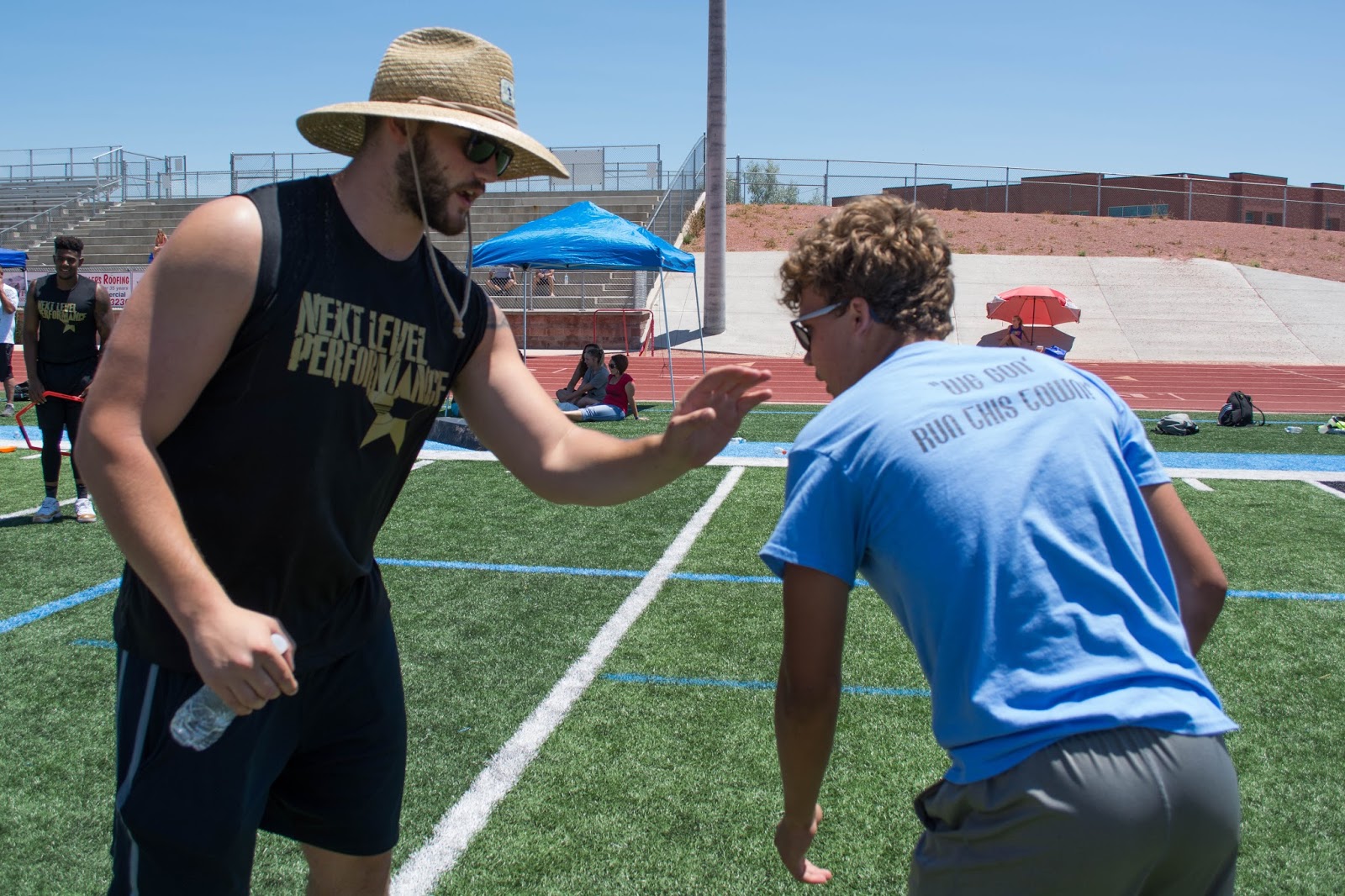
Fox coaches a high school kid at the Next Level Performance camp.
CSU-Pueblo football he participated as coach in every clinic the football team hosted at the Thunder Bowl and served breakfast to members of the community during the annual United Way Breakfast Fund Raiser in Pueblo. As a professional athlete in the National Football League he continues to serve the Pueblo by serving as a coach during the Next Level Performance Football Camp in Pueblo, Colorado. Morgan also took time after the camp to sign autographs and take picture with the kids participating in the camp.

Morgan signs autographs for kids after the Next Level camp in Pueblo, Colorado.


Morgan teaches a kid how to do the LA sign after the Next Level camp in Pueblo, Colorado.


Morgan checks the stances of kids participating in the Next Level football camp in Pueblo, Colorado.

Wednesday, June 22, 2016

Mission: Wolf A safehaven in Southern Colorado


During the late 1800’s fur trappers dominated the landscape of the west. Seeking their fortunes by killing fur bearing animals like beavers, coyotes, foxes, bears, buffalo and wolves. As the beaver, buffalo, and fox populations in the west fell the hunters turned their guns and traps to wolves. Anti-wolf sentiment grew across the US, as wolves were portrayed as being malicious hunters intentionally stalking and killing farmers and ranchers livestock, while simultaneously killing off the deer and elk populations in the west. Former President and conservationist Theodore Roosevelt was quoted from a book he published in 1902 as saying "The wolf is the arch type of ravin, the beast of waste and desolation. It is still found scattered thinly throughout all the wilder portions of the United States, but has everywhere retreated from the advance of civilization." The US government endorsed the eradication of wolves from the US and by the 1960’s wolves were almost completely extirpated from the lower 48 states, with only about 300 wolves seeking refuge in the heavily wooded areas of northern Michigan and Wisconsin. In 1974 the Grey Wolf was placed on the endangered species list and received federal protection from being hunted and killed and re-population efforts of the wolves was started, which brings us to current day, southern Colorado.

  Nestled comfortably between the Great Sand Dunes and Colorado City, in the Wet Mountains sits one of southern Colorado’s hidden gems, Mission: Wolf. Mission: Wolf is a sanctuary for
Garden, greenhouse, and tipi at Mission:Wolf
wolves and wolf-dogs. Mission: Wolf was founded by Kent Webber in 1984 as a means to save wolves and educate people about them. Kent opened the sanctuary with just a couple of wolves and when he reached 52 he realized that the problem of people owning wolves and wolf hybrids was much larger than expected and that he can not save them all. Before becoming a full-time wolf conservationist Kent was an architect. While being an architect may not seem relevant or related it goes hand in hand with Mission: Wolf. Mission: Wolf is completely self-sustaining; solar panels provide electricity, a well provides water, the staff grows their own food, a truck was converted to run off of vegetable oil, the food for the wolves comes
A staff member greets visitors before a tour.
from road kill and local farmers and ranchers that have donated dead livestock or horses. The staff at Mission: Wolf are all volunteers that give up a minimum of six weeks to work at the refuge. When asked about paying the staff Kent said “We don’t have the resources for that. People work here because they want to make a difference for theses animals. As an all-volunteer force, the staff is more willing to help each other, and there is not much completion between individuals, it is all about the animals." Mission: Wolf has very limited housing for its volunteers, most volunteers sleep in one of the tipi's provided or in their own tents in the small camp area.

Mission: Wolf is free and open to the public 365 days a year from 9am-4pm. There is no fee to visit the wolves but a donation is always welcomed. Camping is allowed at Mission: Wolf, free of
Staff members lead volunteers to feed.
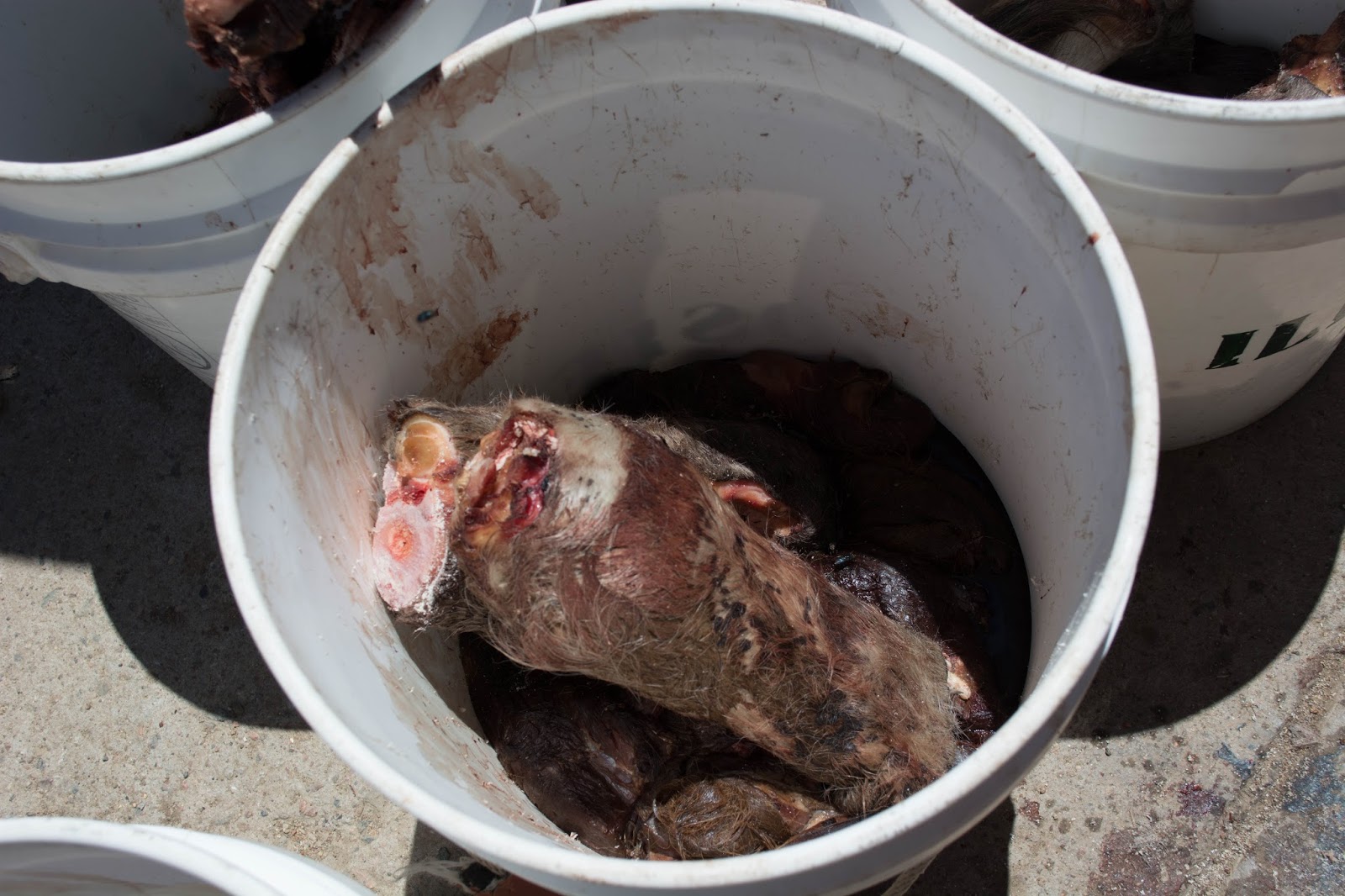
charge but they would like a some help working on a small project from campers in exchange for using the camping area. During a visit to Mission: Wolf guest will be given a tour by one of the volunteers, that shows the wolf enclosures, tells you about the wolves, shows the green houses and gift shop. Wednesday’s and Saturday's are the “big feed” days, on these days large amounts of livestock are chopped up, put in buckets carried to the enclosures and fed to the wolves.  The highlight to a visit at Mission: Wolf is when all the guests sit around Kent and listen to him talk about the wolves, their behavior, and how human behavior is vital to changing the relationship we have with wolves. After sitting with Kent and hearing his instructions the guests are taken inside an enclosure to meet the three ambassador wolves, Magpie, Abraham and Zeab. It is here in this enclosure that people see a wolf, touch a wolf and are greeted by a wolf licking inside their mouths while staring them in the eyes, at that moment a connection is made. The wolves do this day in and day out, it's the humans that make a connection and have experience that can not be replicated in a book, watching a video or found on-line, it is real and it is yours, it can be told and retold but until it is experienced it will not be understood. As Kent said all the wolves want to do is live. After all the exhaustive efforts humans have done to eradicate them the least we can do is dismiss these old notions that all wolves do is hurt ecosystems, and target peoples livestock and pets and embrace them as the beautiful creatures they are and leave them be in the wild.
 

Magpie greets a guest during a visit.
A staff member (right) explains how the greenhouse works to visitors.
A group of Boy Scouts waits to be separated into groups for a tour.

Raw meat that has been chopped and is waiting to be fed to the wolves.
Staff members wait before grabbing the feeding buckets and heading to feed the wolves.
Visitors toss raw meat to the wolves.
A staff member feeds a wolf inside its enclosure.
A wolf carries off some food.
A staff member (right) and volunteers clean the feeding buckets.
A volunteer places the clean buckets on the drying rack.

Kent talks to visitors before they are allowed to meet the wolves.
Visitors are all smiles as Magpie, Abraham and Zeab greet them.
Magpie receives attention from a guest.
Magpie moves from visitor to visitor as a staff member watches.
Magpie gives a visitor a true wolf greeting.

An almost full moonrise over the camping area at Mission:Wolf.


Monday, June 13, 2016

Yellowcake, Arsenic, and Lead....Oh My!!!


Entrance to the Cotter Mill from CR 68.
When we think of Canon City and Pueblo, uranium, arsenic, and lead are not the first things to come to mind, but they should not be the last things either. 
Sign on the fence outside of the Cotter Mill.
The Cotter Mill just south of Canon City began processing Uranium for nuclear weapons and fuel in 1958. For twenty years the Cotter Mill was releasing radioactive waste into unlined ponds on their grounds. In 1982 Cotter began using lined ponds until the mill shut down all operations in 2011. In 1984, testing of some of the wells in Canon City was performed by government officials and it was discovered that there was contamination of the water, leading the government to declare it a Superfund site. Cleanup for the Superfund site began after the study in 1984 and continues through today. The Superfund includes the 2,600 acre area which includes the 640 acre mill and the nearby Lincoln Park neighborhood.  There is concern by some residents of Pueblo, like Pueblo County Commissioner Buffie McFayden that contamination from Cotter has reached Pueblo. McFayden was recently quoted by KOAA saying, “I do believe it's time for Pueblo to get involved and work with the citizens of Fremont County to not only demand a remediation plan that's realistic to cleanup the site, but also to demand testing along the Arkansas in the sediment and in Pueblo Reservoir.” While there is not a definitive answer as to how much contamination there is or isn’t in the reservoir it is feasible to believe there could be some.
Click the link for updated clean-up information: Info
Drainage culvert from Cotter Mill.
A look onto the Cotter Mill site.


Billboard encouraging residents in Bessemer and Eiler to contact the EPA.

Just over forty miles downstream from the Cotter Mill in Pueblo sits the old Eiler’s Smelter another Superfund site. The Eiler’s Mill was known by several names since it began operating in 1883. The smelters were used to smelt extracted silver-lead from the Madonna Mine in Monarch.  The area of the old smelting plant and the Bessemer and Eiler’s neighborhoods were
Slag pile visible from Sante Fe Ave.
declared a Superfund site after an inspection of the Sante Fe Bridge Culvert in the 1990’s revealed a slag pile. Slag is by-product of the smelting process, which contains both arsenic and lead.
When travelling south on Santa Fe Avenue shortly after crossing the bridge part of the 700,000 sqaure-foot slag pile is still visible. The Eiler’s Smelter (under another name at the time) closed in 1908, and soon thereafter the dismantling of the smelter began. In 1924, bricks from the smoke stack were used to build the St. Mary school which is still standing today. People in the Eiler’s and Bessemer neighborhoods are being encouraged to sign up with the EPA to have their homes and property tested for lead and arsenic poisoning. 
Click the link for a map of the Superfund site: MAP
 Click the link for updated clean-up information: Info
 
St. Mary School built from the bricks of the old smoke stack.